Scaling Visual Language Models for Remote Sensing with Open Data and LLMs
Introduction
Vision-language models (VLMs) show great promise for interpreting remote sensing (RS) imagery in human-like ways. However, training effective VLMs requires massive amounts of paired image-text data - a significant challenge in the RS domain.
Our solution? RSTeller - an automated workflow that generates high-quality RS image-text pairs at scale using:
- Openly available RS imagery from Google Earth Engine
- Semantic data from OpenStreetMap (OSM)
- Large language models (LLMs) to generate rich captions

Key Contributions
- Automated Workflow: End-to-end pipeline for fetching RS data, generating captions with LLMs, and compiling datasets
- RSTeller Dataset: 1.3M RS images with 2.6M high-quality captions (2x richer semantics than existing datasets)
- Comprehensive Experiments: Validating dataset effectiveness, ablation studies, and scaling laws
Methodology
Data Generation Workflow
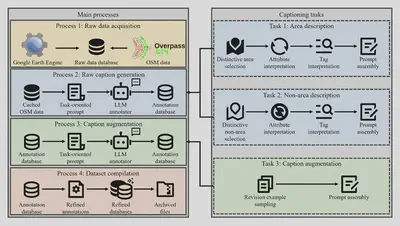
Data Collection:
- RS images from NAIP via Google Earth Engine
- Semantic tags from OpenStreetMap
Caption Generation:
- Task 1: Describe “area” elements (land use, buildings)
- Task 2: Describe “non-area” elements (roads, rivers)
- Task 3: Caption augmentation for linguistic diversity
Quality Control:
- Filter irrelevant OSM tags
- Remove duplicate/hallucinated captions
- Compile into WebDataset format
Dataset Characteristics
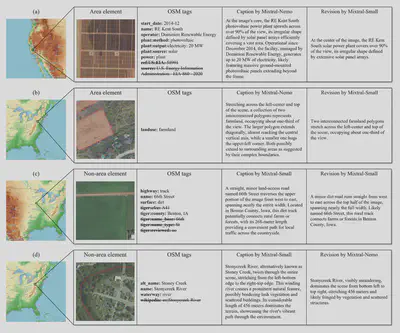
- Scale: 1.3M images, 2.6M captions
- Coverage: Continental US, 0.6m GSD, RGB bands
- Semantic Richness: MTLD score >100 (2x higher than alternatives)
- Geographic Coverage: United States
Key Findings
Dataset Effectiveness
Continual pre-training with RSTeller improves performance across RS tasks:
Zero-shot classification: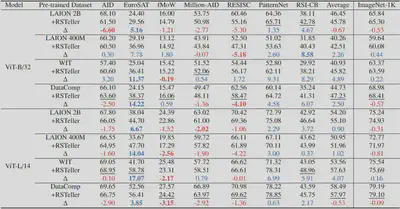
Zero-shot retrieval: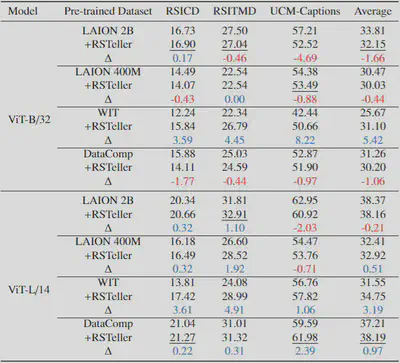
- Average accuracy improvements up to 4.89% (ViT-B/32) and 4.07% (ViT-L/14)
- Best results when starting from DataComp pre-trained checkpoints
- Minimal impact on general-domain performance (ImageNet)
Ablation Study

Key takeaways:
- Common knowledge (LAION-10M) prevents catastrophic forgetting
- LLM interpretation boosts performance (vs template captions)
- Caption augmentation (Task 3) provides consistent gains
- Named entities have negligible impact
Scaling Laws
Scaling laws tested on zero-shot classification:
Scaling laws tested on zero-shot retrieval: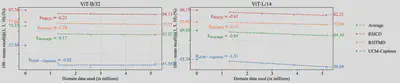
- More domain data → Better performance (negative error slopes)
- ViT-L/14 outperforms ViT-B/32 consistently
- Some benchmarks show initial degradation before improvement
Practical Recommendations
For researchers building RS VLMs:
- Start with robust checkpoints (DataComp pre-trained)
- Include common knowledge data to prevent forgetting
- Use LLMs for caption generation (not just templates)
- Scale domain data continuously - initial drops may recover
- Larger models (ViT-L/14) generally perform better
Limitations and Future Work
Current limitations:
- Single-element focus in captions
- Residual LLM hallucinations
- Limited geographic coverage (US only)
- Simple CLIP architecture
Future directions:
- Multi-element captioning
- Better hallucination suppression
- Global coverage expansion
- More sophisticated VLM architectures
Conclusion
RSTeller provides:
✅ Automated pipeline for RS multimodal data
✅ High-quality dataset (1.3M images, 2.6M captions)
✅ Proven effectiveness for VLM training
✅ Clear path for future scaling
The dataset and code are publicly available to advance RS VLM research. For further details, please refer to the paper. This work has been publised in ISPRS Journal of Photogrammetry and Remote Sensing:
Junyao Ge, Xu Zhang, Yang Zheng, Kaitai Guo, Jimin Liang*, RSTeller: Scaling up visual language modeling in remote sensing with rich linguistic semantics from openly available data and large language models, ISPRS Journal of Photogrammetry and Remote Sensing, 2025, 226: 146-163. IF: 10.6

Jimin Liang
Professor of Electronic Engineering
My research interests include artificial intelligence and computer vision.